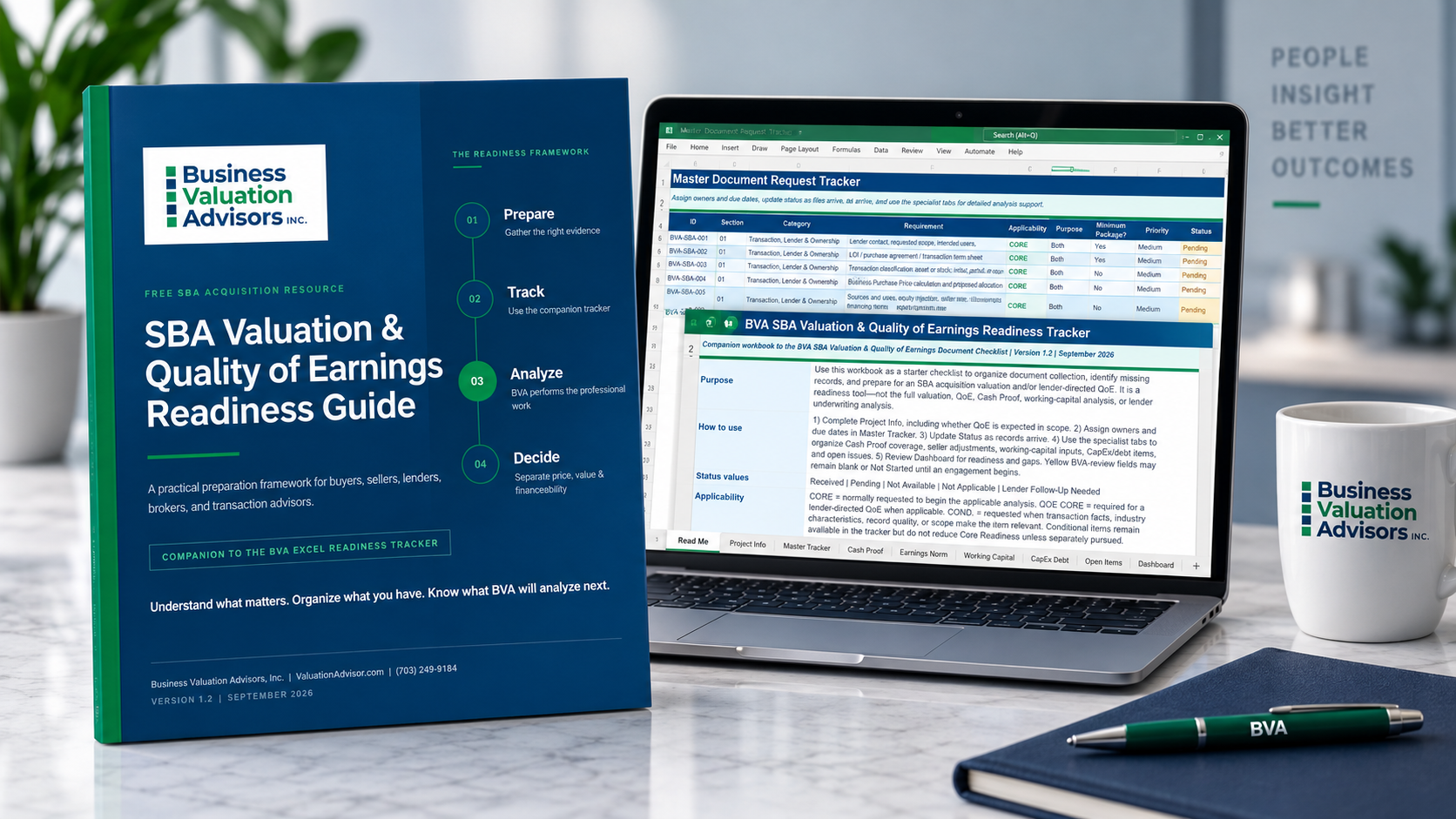
Prepare with confidence — Know which financial, banking, transaction, and operating records may be needed before valuation or QoE work begins.
Spot readiness gaps early — Use the Readiness Tracker in Excel or Google Sheets to identify missing documents, Cash Proof coverage gaps, seller adjustments, and open diligence items.
Understand what BVA will analyze — See how earnings quality, working capital, minimum cash, CapEx, debt, and transaction risk fit into the professional engagement.
What’s Included in the Free Toolkit
Two coordinated BVA resources designed to help you understand what matters, organize your transaction, and prepare for the valuation or Quality of Earnings process.
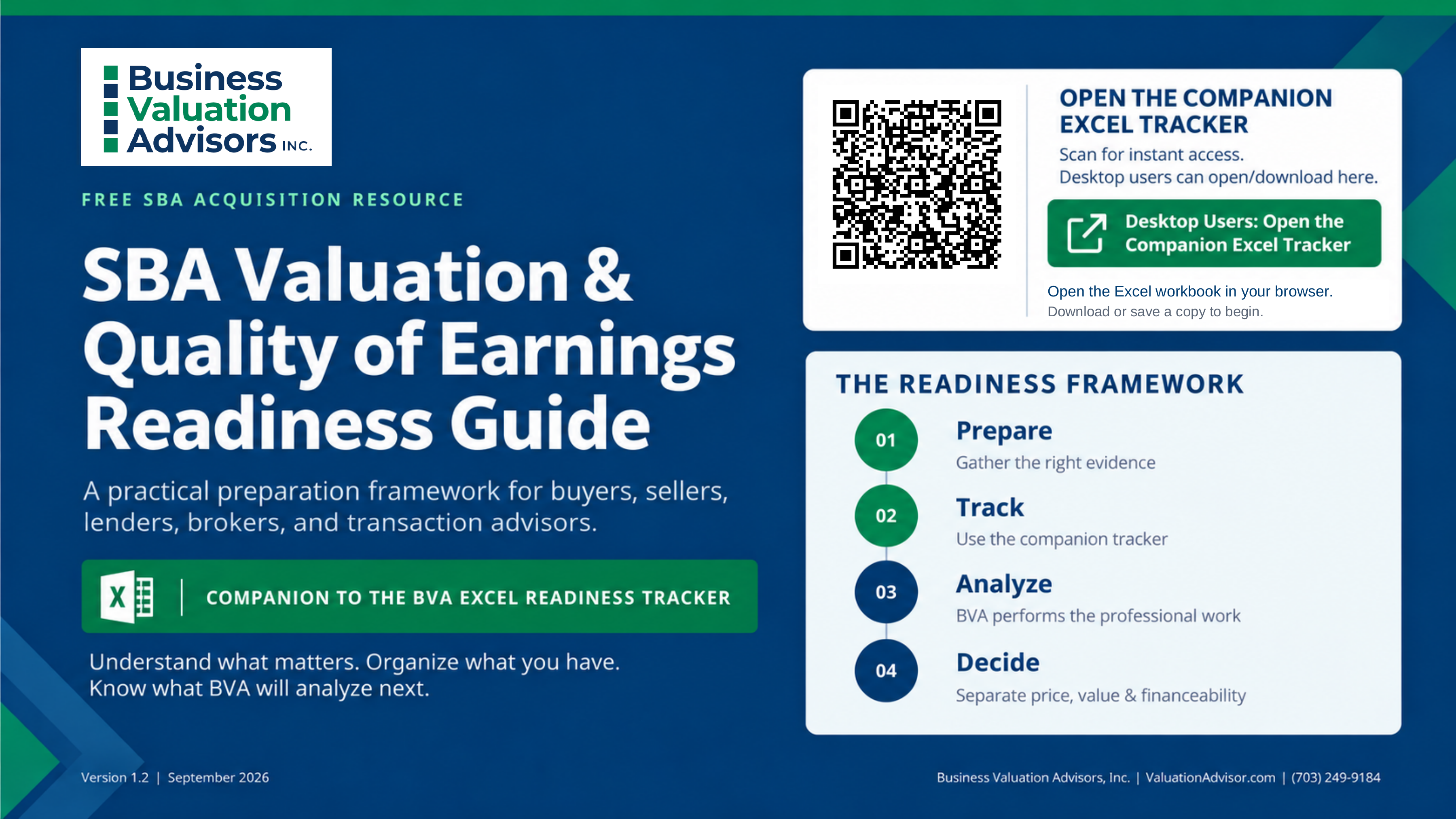
14-Page SBA Valuation & QoE Readiness Guide
Understand what records matter, when the SBA QoE requirement may apply, and how BVA approaches Cash Proof, earnings normalization, revenue quality, working capital, CapEx, debt, and transaction risk. A practical preparation guide for buyers, sellers, lenders, brokers, and transaction advisors.
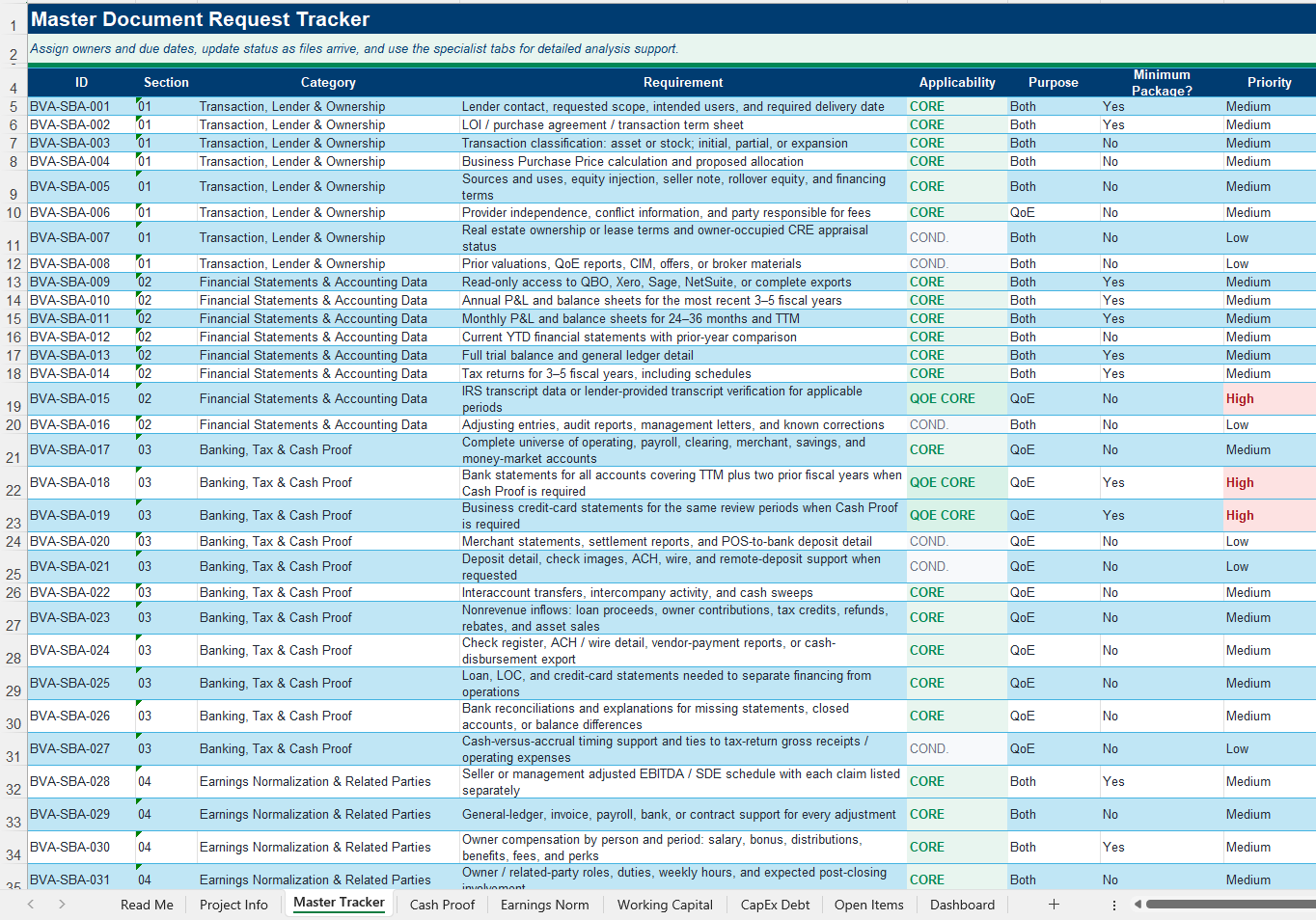
SBA Valuation & QoE Readiness Tracker — Excel + Google Sheets
Turn the readiness framework into a working transaction checklist. Track documents, assign responsibilities, identify missing CORE items, review Cash Proof coverage, organize seller adjustments, and monitor working-capital, CapEx, debt, and open diligence issues. Choose the format that works best for you: download the Excel workbook for desktop use or create your own Google Sheets copy for cloud-based access and collaboration. Built to help buyers, sellers, lenders, brokers, and advisors see what is ready, what is missing, and what a Quality of Earnings team may need next.
SBA Acquisition Diligence Is Changing
For transactions subject to SBA SOP 50 10 Version 8.1 effective October 1, 2026, qualifying Initial Acquisition and Business Expansion transactions with a Business Purchase Price of $3 million or greater require a separate lender-benefit Quality of Earnings report in addition to the required business valuation. But the $3 million QoE rule is only part of the readiness challenge.
Financial Record Reliability
Do the general ledger, financial statements, tax returns, and supporting schedules tell a consistent story?
Cash Proof Coverage
Are all bank, merchant, payroll, clearing, and business credit-card accounts identified for the applicable review periods?
Seller Add-Back Support
Can proposed EBITDA or SDE adjustments be documented, supported, and evaluated independently?
Revenue Quality
Are revenues recurring, concentrated, transferable, collectible, and sustainable after the acquisition?
Working Capital & Minimum Cash
How much operating working capital and minimum cash will the buyer actually need to support normal operations after closing?
CapEx, Debt & Transaction Risk
What recurring reinvestment, debt-like obligations, contingencies, or hidden cash requirements could affect the transaction?
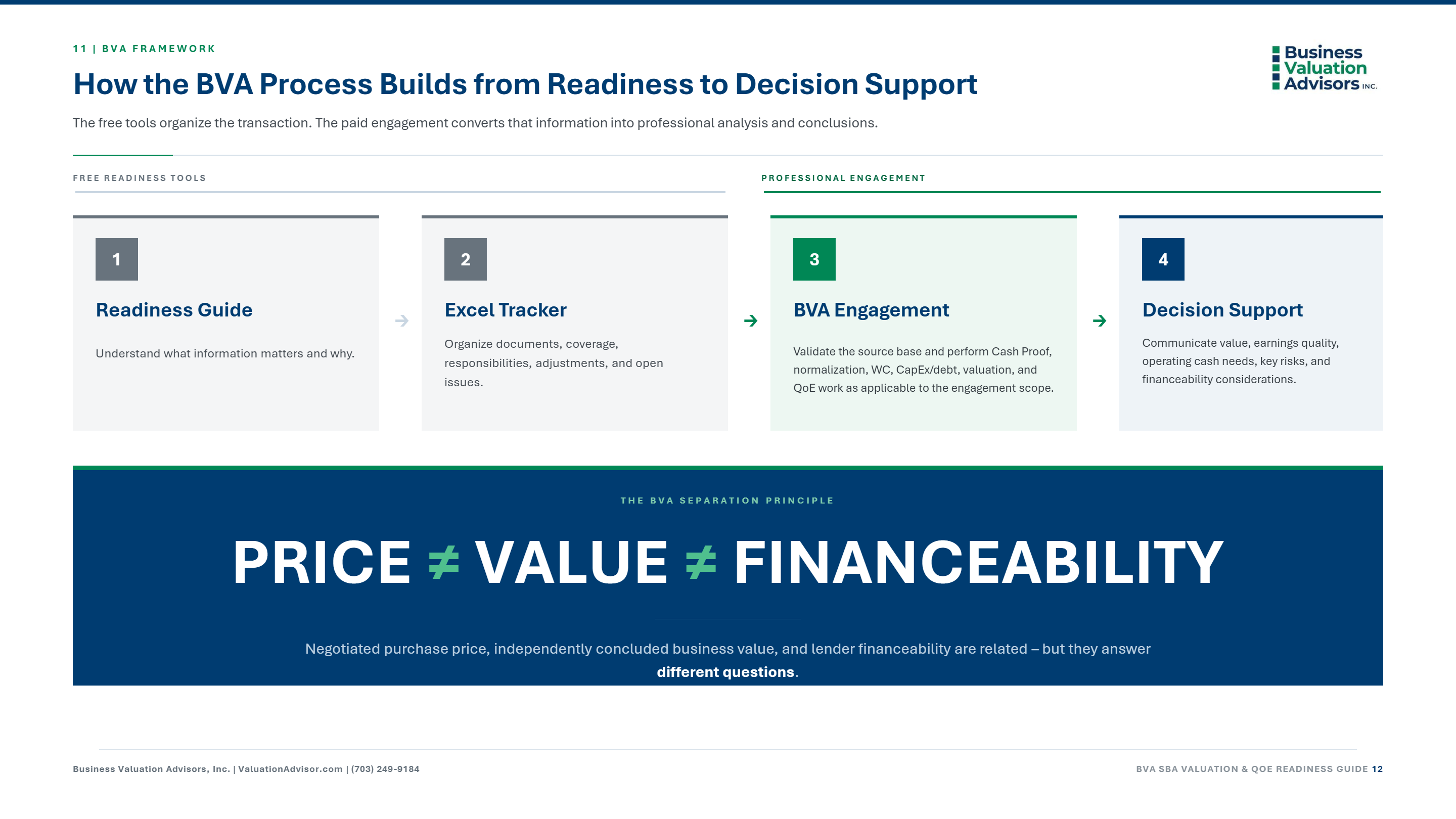
From Readiness to Decision Support
Prepare → Track → Analyze → Decide The free BVA tools help organize the transaction before professional analysis begins. The Readiness Guide explains what matters, while the Readiness Tracker—available in Excel and Google Sheets—helps organize documents, responsibilities, Cash Proof coverage, seller adjustments, working-capital inputs, and open issues. When BVA is engaged, we validate the source information and perform the valuation, Quality of Earnings, Cash Proof, earnings normalization, working-capital, CapEx/debt, and transaction analysis applicable to the assignment. PRICE ≠ VALUE ≠ FINANCEABILITY Negotiated purchase price, independently concluded business value, and lender financeability are related—but they answer different questions.
Built for SBA Acquisition Deal Teams
The toolkit is designed for buyers, sellers, lenders, brokers, accountants, attorneys, and other advisors who need a clearer view of transaction readiness before valuation or financial diligence begins.
Buyer / Searcher
Understand what financial records to request, where diligence gaps may exist, and what issues could affect value, cash needs, or financing.
Business Owner / Seller
Prepare financial records, support seller adjustments, identify missing information, and reduce avoidable surprises before buyer or lender diligence begins.
SBA Lender
Help borrowers and deal teams understand the information that may be needed for business valuation, Quality of Earnings, Cash Proof, and acquisition underwriting.
Business Broker / M&A Advisor
Give clients a structured readiness framework and identify financial diligence issues before they slow down the transaction.
CPA / Accountant
Understand the financial records, reconciliations, adjustment support, and operating information BVA may request during an acquisition engagement.
Attorney / Transaction Advisor
Identify financial and transaction issues that may affect purchase terms, working capital, liabilities, closing requirements, or post-closing risk.
What a Serious Quality of Earnings Review Actually Examines
A Quality of Earnings review is more than a review of seller add-backs or adjusted EBITDA. Depending on the engagement scope, BVA evaluates whether reported earnings are supported by the underlying records, cash activity, revenue quality, operating requirements, and transaction-specific obligations.
Cash Proof
Does actual bank activity support the revenue and operating expenses reported in the financial statements and tax records?
Earnings Normalization
Which seller adjustments are accepted, reduced, rejected, or offset by negative adjustments needed to develop supportable earnings?
Revenue Quality
Are revenues recurring, concentrated, collectible, transferable, and likely to continue after the acquisition?
Working Capital & Minimum Cash
What level of operating working capital and minimum cash is needed to support normal operations after closing?
CapEx & Hidden Cash Requirements
What recurring reinvestment, deferred maintenance, or other cash needs could reduce the earnings available to the buyer?
Debt & Transaction Items
What funded debt, debt-like obligations, contingencies, or transaction-specific balances may require payoff, adjustment, or buyer funding?
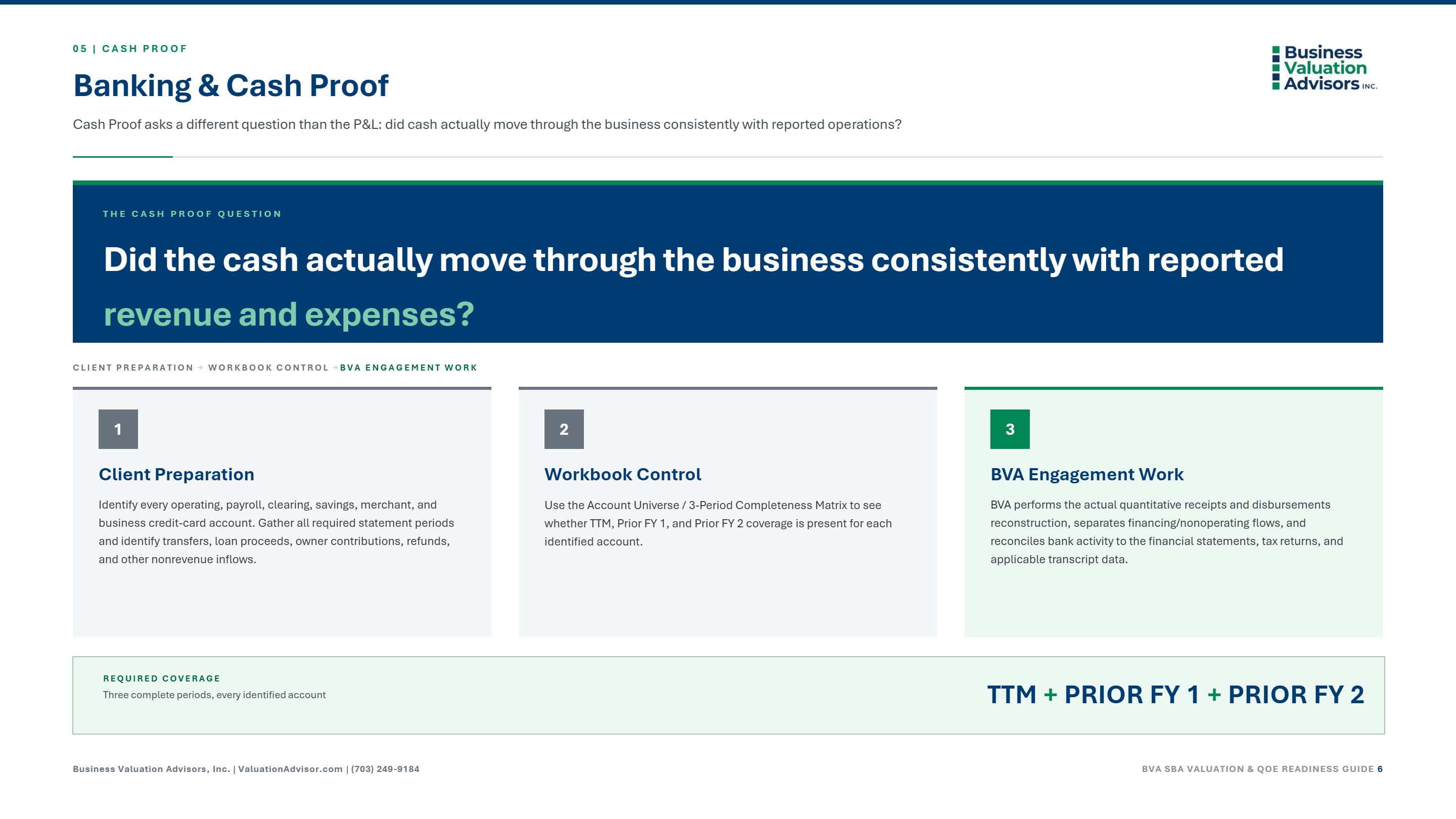
What Is Cash Proof in an SBA Quality of Earnings Review?
Cash Proof tests whether reported operating activity is supported by the actual movement of cash through the business. When Cash Proof is required, the analysis goes beyond simply collecting bank statements. BVA identifies the complete account universe, reconstructs receipts and disbursements, separates transfers, financing proceeds, owner contributions, refunds, and other nonoperating flows, and reconciles bank activity to the company’s financial statements, tax returns, and applicable transcript data. For applicable SBA lender-directed QoE engagements, the review may require complete coverage for the trailing 12 months plus the two prior fiscal years. TTM + Prior FY 1 + Prior FY 2
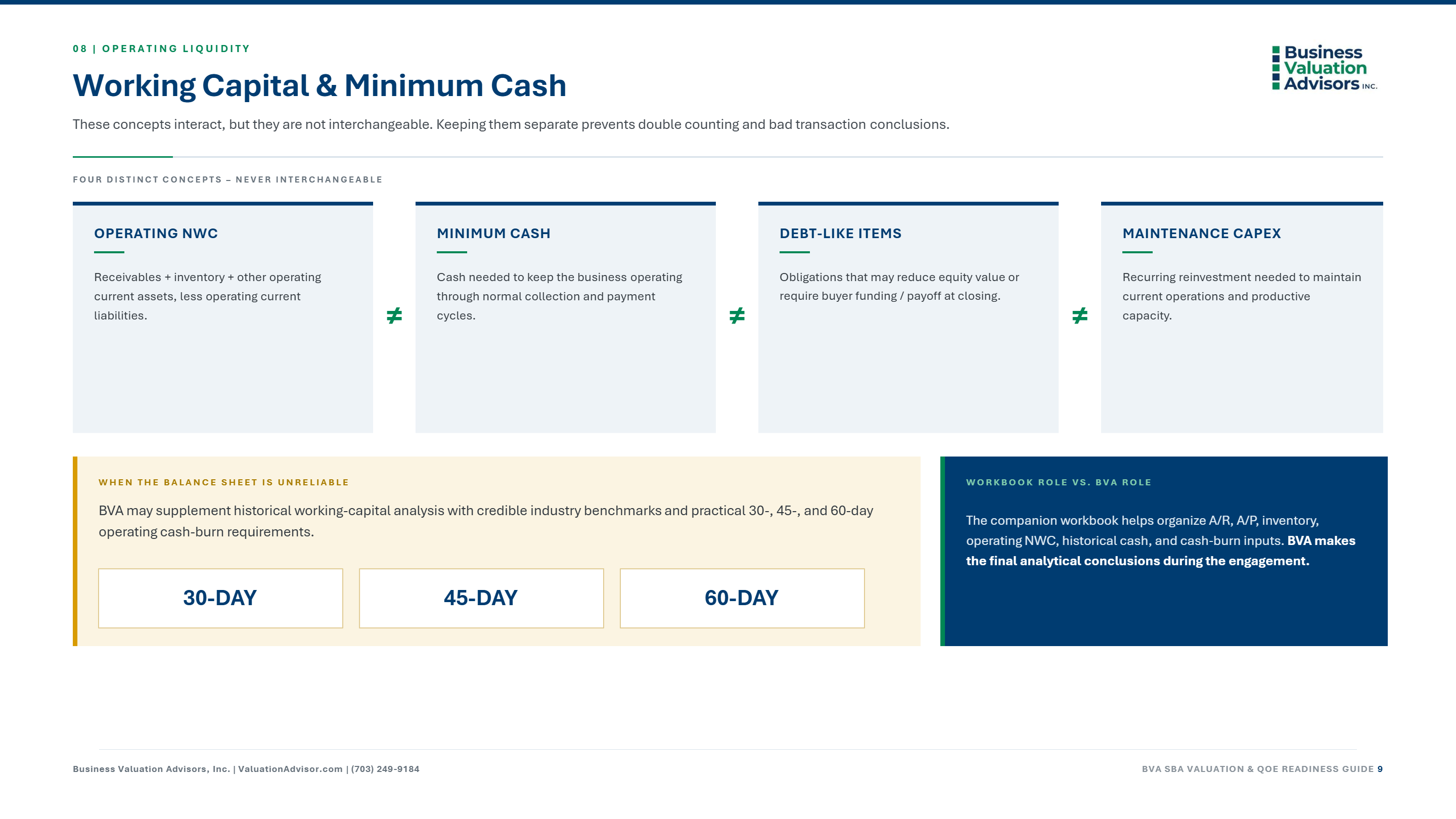
Working Capital & Minimum Cash in an SBA Business Acquisition
Working capital, minimum operating cash, debt-like items, and maintenance CapEx all affect transaction economics—but they are not interchangeable. Operating net working capital generally reflects the receivables, inventory, and other operating current assets needed to run the business, less operating current liabilities. Minimum cash is different: it is the liquidity the business needs to continue operating through normal collection and payment cycles. When historical balance-sheet information is unreliable, BVA may supplement the analysis with credible industry benchmarks and practical 30-, 45-, and 60-day operating cash-outflow equivalents used as planning references, not as a concluded minimum-cash requirement. Operating NWC ≠ Minimum Cash ≠ Debt-Like Items ≠ Maintenance CapEx
SBA Valuation & Quality of Earnings FAQ
Common questions about SBA acquisition valuation, Quality of Earnings, Cash Proof, working capital, and transaction readiness
What Is a Quality of Earnings Report?
A Quality of Earnings, or QoE, report evaluates the reliability and sustainability of a company’s reported earnings. Depending on the engagement scope, the analysis may include financial-record reconciliation, Cash Proof, earnings normalization, revenue quality, working capital, CapEx, debt, and other transaction-specific considerations.
When Is a QoE Required for an SBA Acquisition?
For transactions subject to SBA SOP 50 10 Version 8.1 effective October 1, 2026, a separate lender-benefit Quality of Earnings report is required for qualifying Initial Acquisition and Business Expansion transactions when the applicable Business Purchase Price is $3 million or greater.
What Is Cash Proof in an SBA QoE?
Cash Proof tests whether reported operating activity is supported by the actual movement of cash through the business. The analysis may reconstruct receipts and disbursements, separate transfers and nonoperating flows, and reconcile bank activity to financial statements, tax returns, and applicable transcript data
What Documents Are Typically Needed for an SBA QoE?
Common records include historical and current financial statements, tax returns, the general ledger, trial balance, bank and business credit-card statements, payroll records, seller-adjustment support, customer revenue information, A/R and A/P schedules, debt schedules, and other transaction-specific records.
How Many Periods of Bank Activity May Be Needed for SBA Cash Proof?
For applicable lender-directed QoE engagements, Cash Proof may require complete coverage for the trailing 12 months plus the two prior fiscal years, including the relevant bank, merchant, payroll, clearing, and business credit-card accounts.
What Is the Difference Between an SBA Business Valuation and a Quality of Earnings Review?
A business valuation develops an independent conclusion of value. A Quality of Earnings review evaluates the reliability and sustainability of reported earnings and related transaction risks. The analyses are related, but they answer different questions and may both be required in certain SBA acquisition transactions.
How Are Seller Add-Backs Reviewed in a Quality of Earnings Analysis?
Seller adjustments should be evaluated individually and supported with underlying records. Depending on the facts, BVA may accept, reduce, reject, or offset an adjustment with a negative adjustment when developing supportable normalized earnings.
How Does Working Capital Affect an SBA Business Acquisition?
Working capital can affect the amount of operating liquidity a buyer needs after closing and may influence transaction structure, purchase-price mechanics, and lender underwriting. Operating NWC should be evaluated separately from minimum cash, debt-like items, and maintenance CapEx.
Does a Quality of Earnings Review Determine the Value of the Business?
No. A Quality of Earnings review evaluates the reliability and sustainability of reported earnings and related transaction considerations. A business valuation develops the independent conclusion of value. Price, value, and financeability are related—but they are not the same thing.
How Is Business Purchase Price Calculated for the $3 Million SBA QoE Threshold?
For the Appendix 15 readiness screen, Business Purchase Price is generally determined by taking the Purchase Agreement Price and subtracting the appraised value of applicable owner-occupied commercial real estate. Buyer equity, seller financing, and other financing sources do not reduce the purchase price for purposes of the threshold. Final applicability should be confirmed with the lender.
Are Owner Buyout and ESOP or Cooperative Transactions Subject to This SBA QoE Requirement?
Owner Buyout and ESOP or Cooperative transactions are not subject to the particular Appendix 15 QoE requirement described on this page. Other valuation, lender, transaction, or diligence requirements may still apply depending on the facts of the transaction.
Who Should Approve the Quality of Earnings Provider for an SBA Transaction?
For a lender-directed SBA QoE, the lender should confirm the provider’s acceptability, independence, scope, intended users, and required deliverables before fieldwork begins. Buyers and sellers should avoid assuming that a separately commissioned QoE will automatically satisfy the lender’s requirements.
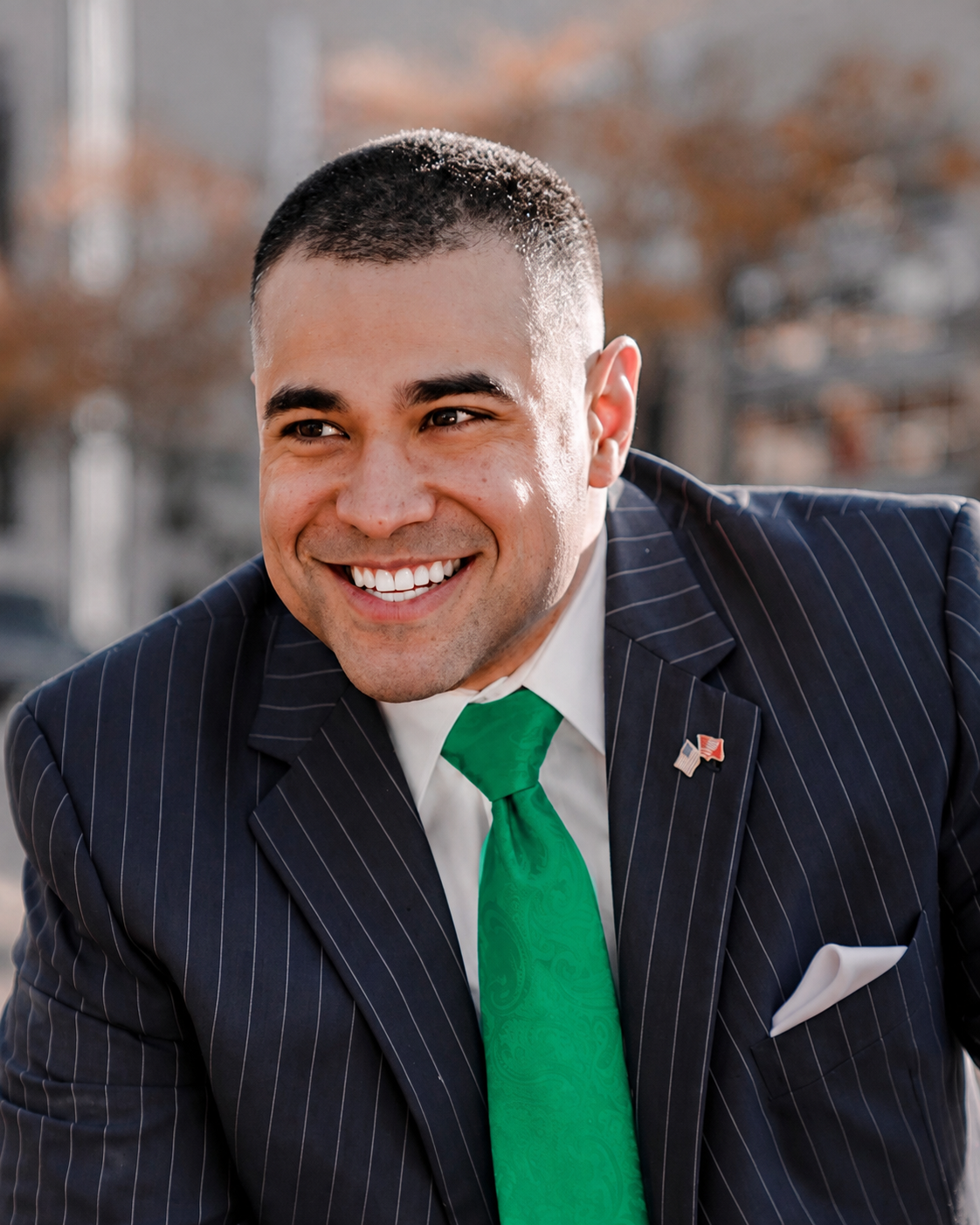
Why Business Valuation Advisors?
Business Valuation Advisors, Inc. helps buyers, sellers, lenders, and transaction advisors evaluate privately held businesses through business valuation, Quality of Earnings, Cash Proof, working-capital analysis, SBA acquisition analysis, and transaction advisory services. BVA’s approach is built around one principle: the numbers should support the transaction decision—not simply produce a report. That means examining the reliability of the financial records, the sustainability of earnings, operating liquidity needs, CapEx, debt and transaction risks, and the distinction between purchase price, business value, and financeability. Joshua Himan, CVA® | Founder & CEO Business Valuation Advisors, Inc. | ValuationAdvisor.com
Get the Free SBA Valuation & QoE Readiness Toolkit
Get the 14-page SBA Valuation & Quality of Earnings Readiness Guide and companion Readiness Tracker—available in both Excel and Google Sheets—to organize documents, identify readiness gaps, and prepare for business valuation, Quality of Earnings, Cash Proof, and lender diligence.
Enter your information below for immediate access to the free toolkit